In a performance by Anja Carr you are just as likely to see furries, a children’s book character, and a human playing the role of an anthropomorphised animal. Within her sphere, the distinctions between the real and the imaginary become largely irrelevant, or at least they feel that way in the realm of the pictures. Between her performances and their photo and video documentation she tweaks the senses, creating a collision between levels of abstraction that leaves the world, with its slippery distinctions, feeling unsettling and strange. It’s not necessarily a bad kind of strange however, and for some might even feel idyllic in its imprudent naivety.
You can checkout more of Anja work’s on her site. She also runs PINK CUBE, a super awesome, totally inspiring experimental gallery in Oslo.

diga.rt: Within your performances you play with characters from a both personal and collective childhood; like Pippi Longstocking, My Little Pony, Miss Piggy, etc. Played out before an adult audience by adult performers, I imagine for many the works might feel a bit irreverent or perverse. You’ve stated in a previous interview that “Through play we discover our dark side”… In what ways do you think play allows us to exist differently than we exist normally, and in what ways do you see art-making as a form of play?
AC: Play is kind of like a dream-state, you improvise and you more easily connect with your unconsciousness and with desires you didn’t know about. As in play, artists often create their own rules within the work, at least artists that work like me; creating their own little universe. I don’t think there needs to be any distinction between taking your profession as an artist very seriously and having fun playing at the same time.

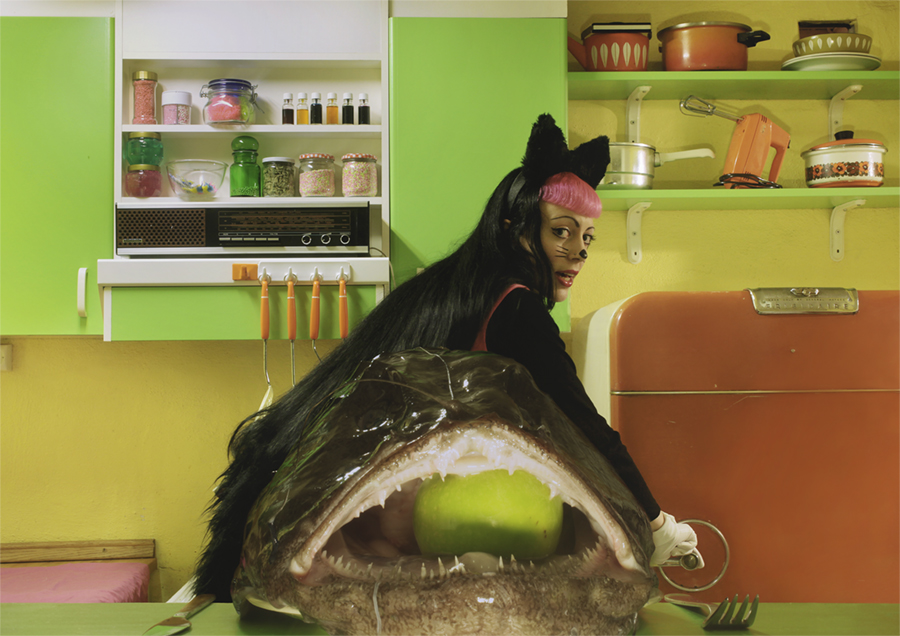
diga.rt: The images featured here are part of an ongoing series called Moments (Act 1-9), in which different performances are represented in individual photographs. The documentation of your performances and their dissemination online creates really different experiences for viewers who are seeing the performances as individual images versus those who are privy to the initial live-performances. Do you think this dissemination model impacts the act of performing as well?
AC: Photography was actually my starting point, so I guess I always think in pictures somehow. I did my first photography-show at 14 together with my colleague Tonje Bøe Birkeland. Later, when studying at the Art Academies in Bergen, Berlin and in Oslo I tried out all kinds of other media.
Now I’m somehow back to where I started, with my main focus being performances within installations with my handmade costumes, which all ends up in this photo-series. However, when performing I don’t think about the camera, it’s all about the here and now. This is of course a little different when I stage other people and I’m behind the camera. I communicate physically with the audience through non-verbal play and the installations are usually surrounding them and me – they’re not 2D at all. I always try to catch the essence of the live-situation when selecting the photo and translate the feeling of the room even though it’s impossible.
What we miss out on in these www-times with the constant flow of images is interesting. By presenting just one photograph from each performance I want to create a similar void where you have to use your own imagination to complete the narrative. Putting them together as a series also opens up new stories. www- is also why I need to communicate through the live-format I think. The clashes between 2D and 3D, between representation/ fantasy and the physical world and what cameras and screens cannot catch interests me.
diga.rt: While reading an interview with the artist Jon Rafman I discovered the site Gurochan, a super fucked up message board for erotic snuff fiction, among other things. What is particularly intriguing to me about the stories is that the narrators often explore perverse acts within an alternate reality that is devoid of our sense of ethics or morality. In your work there is a similar candidness to the imagery being presented. In what ways do you think the internet allows these fantasies to be played out in ways they can’t typically be IRL (at least outside a consensual space like a performance or a convention)?
AC: Of course screens create a distance that makes it easier to say or do things that you wouldn’t if you saw the reactions on peoples’ faces IRL. Children growing up with smart-phones have more troubles reading body language. It’s funny how we think we get closer through social media, but we miss the very essence of being together, the physical presence. At the same time there is of course a great freedom online when you can hide from dominating categories like age, gender and appearance. I’ve collaborated with the subculture of furries with anthropomorphic fur-suits, covering their faces and bodies, for the same reason.

diga.rt: Much of your work plays with materializing childhood fantasies and contemplating the results. In Horseplay you have a battle with a representation of a horse. Crawling out its vulva wearing a rubber horse mask, you then struggle to make it get up for you to ride while dressed as Pippi Longstocking. In Pig in the middle / Between me and you / Between now and then, a version of Miss Piggy feeds a live hog, and in You Make Me, I Make You, a two-legged pig has a body made from dried bacon. What interests you about moving between the fantastical, the real, and the fetishistic?
AC: It fascinates me how different people can see the same image in so many different ways. The taboos around childhood and sexuality as well. How commercials sexualize our gaze and at the same time limit our understanding of what can be attractive.

diga.rt: In addition to your artistic practice you also run the space PINK CUBE, a pink-walled gallery that hosts “battles” between artists in which the exhibition format becomes more performative. Much of your own work is also collaborative, and often follows a more nightlife mentality than the typical gallery performance. In what way, do you think working/ running a gallery in Oslo has shaped your taste for collaboration and in what ways do you think it opens the door to new possibilities?
AC: I simply wanted to contribute to the artist-run scene and offer an alternative to the commercial galleries and the typical sterile white cube. When you do things differently there is of course negative reactions too and I’ve learned more about who and what I should use my energy on. Mostly the outcomes of the battles have been surprisingly fruitful and non-violent…
The ongoing show is “Battle 17: Josefine Lyche vs. Richard Øiestad”. I have planned to invite Lyche since I started PINK CUBE in 2011, but couldn’t find a good match for a battle until now. My previous collaborations have been very much in the here and now, but with PINK CUBE I appreciate working on multiple projects at the same time and allowing things to take some time.
Battle #17 is one example that directly led to new possibilities. Lyche has been running a gallery called LYNX for the last year and because we learned more about our common artistic interests and enjoyed working together she invited me to exhibit there.

diga.rt: Pink Cube’s famed painted wall’s have the additive of an undisclosed bodily fluid, making the space have a strange sort of interiority and intimacy. In many of your works you similarly play around the abject, both overtly and more flirtatiously. What is it about the abject that interests you?
AC: I guess it’s the human need to categorize things and how disturbing it is when they fall out of that order. The tipping point is when things can be more than one thing at the same time. Like a stranger’s hair in your shower, that looks beautiful on the head, but suddenly turns into something disgusting and too close. It makes you think twice about your reactions and the situation you are in. Also it’s still more unexpected for a female artist to do disgusting stuff apart from the typical naked-performances with bodily fluids, and that’s interesting.
diga.rt: Do you have any unrealized projects or hopes for the new year?
AC: Apart from the upcoming program at PINK CUBE and the show I mentioned at LYNX, I’m planning a duo-exhibition with Tonje Bøe Birkeland in NYC 2015. In 2013 we participated in the same group-show as artists we’ve looked up to for years; A K Dolven and Judy Chicago among others, at Bontelabo in Bergen. it’s great working with somebody with a lot of the same references who knows you really well!
Right now, I’m working on some more My Little Pony-costumes in leather and want them to interact with bodybuilders that I’ve also worked with in previous projects. They treat their bodies almost as sculptures, just like I treat my costumes and they’re somehow dysfunctional too.
Christian Tony Norum invited me for a big group show at Edvard Munchs studio at Ekely in Oslo and I’m excited to work in such a loaded room! I’m looking forward to work with the Oslo-gallery NoPlace too this year and another possible project involves models in Paris for an experimental UK-magazine. I’m hoping for great and challenging collaborations in 2015!

:::FIN:::