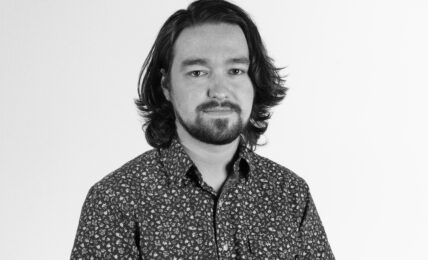
Digital America interviewed Nicol Eltzroth Rosendorf in April 2026 on their work Surface Deletion Archive.
:::

Digital America: You describe Surface Deletion Archive (2026) as a generative artwork that “cannot preserve what it contains,” producing a damaged surface of persistence rather than actual memory. How does this work reflect your thinking about digital persistence and human memory, and what tension do you see between the two? Do you understand the piece as pointing to a loss, a transformation, or something else entirely?
Nicol Eltzroth Rosendorf: One of the things I keep circling back to is a confusion of scale and site. What’s internal and what’s external, personal and collective, memory and feed. Those boundaries don’t feel all that stable anymore, and Surface Deletion Archive sits right in that blur. It pulls from external systems, but the experience of it feels close to something internal: the way things accumulate, interfere, get partially erased, then return in altered form. I don’t really buy the idea that digital systems preserve anything as we tend to imagine. They store and retrieve, but that’s not memory. Memory is patchy, selective, and improvised. It gets rebuilt. Digital persistence can look cleaner, but it’s brittle in its own way. Change the system, lose access, shift the format, and it starts to fray. The work sits somewhere between those two conditions. It accumulates material and begins degrading it immediately, so what you get isn’t a record so much as a surface under pressure: overwritten, partially legible, and always shifting. Time feels like the real tension in the piece. Everything arrives, stays briefly, then gets displaced. The work also aims to help me metabolize the firehose of current events without feeling completely flattened by it. The piece doesn’t solve that, but it does give that pressure somewhere to go. So I don’t see it as pointing to loss or lack. It feels closer to exposing how unstable the idea of holding onto anything really is. Even the text that tries to explain the work ends up inside the work, subject to those same conditions.
DigA: The artwork engages with the attention economy as a larger systemic condition, in which digital platforms turn human focus into a quantifiable and increasingly scarce resource. How do you see these larger forces shaping the algorithms that structure our daily feeds, and how does the recursive overwrite in your work reflect the fatigue and instability that can result from this constant cycle of consumption?
NR: I have a reflexive reaction to the phrase “attention economy.” It names something real, but a little too politely. There’s nothing neutral about it. It feels extractive and predatory. What’s being captured isn’t just attention in the abstract, but time, nervous system bandwidth, emotional reactivity, and the already fragile mechanisms people use to orient themselves. It feels ouroboric, except the snake is running out of tail. It has consumed so much of its own substance that it has to keep inventing new ways of feeding: new compulsions, new appetites, new densities of noise, new emergencies. Problem and solution fold into each other. The thing that overloads you then offers itself as the paid tool for managing that overload. At the level of experience, that seems to produce fragments that can’t cohere. You take in more than you can hold, and almost nothing gets time to resolve before the next thing arrives demanding a response. The work behaves similarly. It takes in more than it can contain, and you watch it try and fail to stabilize. That isn’t really a metaphor laid on top of the piece. It’s very close to the piece’s actual structure. Overwrite starts to feel like the nearest thing the system has to a logic.
DigA: You note that Surface Deletion Archive approaches contemporary digital life “not as access to events, but as their repeated degradation into signal, noise, and compulsion”. As the web becomes increasingly saturated with automated content and AI-generated noise, how do you see the role of the browser-based artist evolving to document or disrupt this changing digital ecosystem?
NR: A lot of computing, and really communication more broadly, has drifted into feeds, chats, apps, and other pseudo-ambient pseudo-social systems, so “browser-based artist” already feels a bit dated, even if the underlying conditions haven’t changed all that much. They’ve mostly migrated.
There’s also an assumption that we’ve entered an age of noise, as if things were once coherent. I’m not so sure that was ever true. It’s louder now, faster, and the tools are more readily available, so thoughtful work and disposable output are going to pile up, often indistinguishable for a while. What does seem different is the scale and density of the confusion. At a certain point, noise stops feeling like background interference and starts becoming part of the environment itself, almost a new ontological layer laid over the old one. That hypercomplex condition is shaped by speed, recursion, overload, and increasingly unstable relations between signal and interpretation. Under those conditions, some bad actors will inevitably learn to use the confusion for their own ends. Truth doesn’t disappear, exactly, but it does become easier to bend once people get acclimated to environments where contradiction, distortion, and overload become normalized. Surface Deletion Archive uses the browser in an ambivalent way. It makes sense to me that the work lives in the same environment as the feed it engages with. That part feels integral, not incidental. But I also prefer it projected. I’m not immune to spectacle, and there’s something important about pulling it out of the personal screen and into shared space, where the scale changes what it means to be inside it. A browser window you can close. A wall you can’t.
DigA: Could you walk us through how you curate or scrape the specific images and textual fragments that feed into this system, and what dictates the generative rules of their layering and eventual degradation?
NR: There’s no curation, and that’s intentional. The system pulls from RSS feeds and image streams and takes what shows up. No filtering, no balancing, no taste-making. A feed in the most literal sense. What I shape is what happens after intake. Images and text get layered, scaled, partially erased, and eventually buried as the system moves through different states: taking in more, overwriting more aggressively, nearly wiping itself out, then starting again. So the structure comes from pressure, not selection. The system isn’t trying to accurately or comprehensively represent the world. It’s metabolizing input under duress. There’s also a text on the site, organized as prose in sections, that began as a way of thinking through the work conceptually. That text eventually got folded back into the code as a variable, parsed into sentences and clauses, and fed into the system on the same terms as the headlines. A sentence about erasure gets erased. A phrase about overwriting gets overwritten. The explanatory text couldn’t remain outside the process it was describing, which feels right. Nothing really stands out from the condition. I did build in a couple of small relief valves. Every so often, it pulls in kittens or nature imagery. I may be a miserabilist, but I’m not a sadist, despite the acronym doing me no favors there. Even more seldom, the system suggests that the viewer breathe. There’s also a rule that crosses out the word “Trump.” It began as a dumb, slightly impotent gesture. But once it was running, it stopped feeling like commentary and started feeling diagnostic. The repetition becomes so dense that the name starts to function less like a subject than like a black hole of organized unreason, where spectacle, aggression, distortion, and a ravenous, coercive attention seeking acquire enough density to bend everything else around them. Not because anything reduces to him, but because he condenses so many of the moment’s worst tendencies into one omnipresent signal. At that point, the crossed-out name stops reading as a joke or editorial flourish and starts operating more like a measurement device. It begins to make visible the gravitational pull of recurrence inside a system already running through its own substance and constantly inventing new ways to extend itself. The gesture is blunt, but the bluntness helps. It shows how certain signals no longer simply appear in the feed. They warp the field around them
DigA: In your biography, you mention that alongside your independent art practice, you are the founder of Studio NR and have developed media for major global brands. Commercial branding often relies heavily on capturing and holding attention within the very “feed logic” your artwork critiques. How does your professional experience operating within commercial digital spaces shape your approach to dismantling those same systems in your independent generative art?
NR: Most of my commercial work has been in filmmaking, motion graphics, and commercial production, usually with teams, shaping and executing ideas in service of someone else’s concept or a larger brand system. Practical work. You learn how to structure attention and make something communicate clearly and quickly. I don’t really think of my studio work as dismantling those systems. It’s more than I’ve come to understand some of those tools from the inside. In commercial contexts, the aim is resolution: get the message across, make it memorable, hold attention. In the studio, some of those same instincts are still there, but they’re pointed somewhere else. Instead of resolving, things accumulate. Instead of clarifying, they interfere. I’m still shaping how something unfolds in time, but I’m no longer trying to resolve it cleanly. The structure reveals itself, including where it breaks. There’s a release in that. After years of working toward precision and control, it’s useful to have a space where things can exceed that, where the excess becomes part of the work.
DigA: As a multidisciplinary artist and musician working with sound, moving images, and text, how does your understanding of rhythm, pacing, and duration influence the way you structure time in a generative browser-based work like this? What surprising patterns or behaviors has the system produced as it evolves on its own?
NR: This definitely comes from music, especially from working with drones and loops, where duration and accumulation matter more than discrete events. At a certain point, you stop following individual moments and start feeling the field. SDA behaves similarly. It builds, breaks down, and builds again, and every now and then there’s a brief opening where things almost cohere before slipping away. Psychologically, that feels very familiar to me. You think you’ve caught something. You haven’t. What’s been more surprising is how often SDA and systems like it arrive at aesthetic moments that feel right. Not designed exactly, just arrived at. Sometimes that rightness registers as beauty, and sometimes as something harder to name, a brief numinous charge that seems to emerge from the pattern before it slips away again. When I loosen control enough, it starts to feel less like authorship and more like attention. The system generates a pattern; I meet it, or I don’t. Those moments aren’t random, but they’re not fully mine either. They happen somewhere in between.
DigA: More broadly, how do procedural drift, partial erasure, and the surrender of full authorial control inform your wider artistic practice and your position within the digital ecosystem? What are you working on now?
NR: Drift and partial control are central to what I’m doing. I’m generally less interested in fixed works than in systems that keep going, taking things in, transforming them, wearing them down. A lot of that comes from trying to stay with things that don’t resolve. Rather than forcing an answer, I build structures that let the question keep moving. One current work is Ambient Etiquette, a generative, algorithmically edited video piece where fragments of gesture, speech, sound, and music are continuously recombined in real time. It takes the form of a surreal social environment shaped by pressure, decorum, bodily need, and small failures of control. The audio is central. It keeps trying to stabilize or redirect what the image is doing, sometimes sharpening the emotional logic, sometimes throwing it further off balance. Over time, the piece becomes less about any single scene than about the unstable effort to hold composure, meaning, or form together at all. Concurrently, I’m set to release De-Arranged, a new record of cover songs that approaches familiar material through displacement, distortion, and recomposition, letting different structures and emotional registers emerge. Across all of this, I’ve been letting in more levity, more absurdity, more of the slightly ridiculous, not as a major tonal shift, but because the work can’t live in only one register if it’s going to remain responsive. Humor and ambiguity open things up. They allow multiple meanings to coexist, to form constellations rather than conclusions. And at a certain speed and density, meaning doesn’t only break down. It also multiplies. New associations become possible. New qualities emerge. I’ve always been drawn to that zone where things don’t resolve cleanly, where they stay open and a little unstable.
:::
 Nicol Eltzroth Rosendorf is an Atlanta-based multidisciplinary artist, creative director, and musician whose work moves across moving image, sound, text, installation, and generative systems. His practice investigates memory, language, scale, and recursive transformation through browser-based works, time-based media, sound, and hybrid physical/digital forms. Drawing on a long parallel career in motion design and commercial image production, he brings both technical fluency and conceptual instability into works that examine how systems accumulate, distort, and erode meaning. His work has been exhibited internationally and often takes the form of unstable archives, procedural environments, and durational structures.