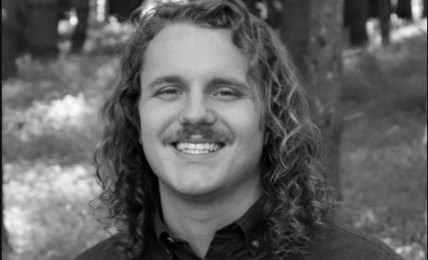
Digital America Interviewed Cody Tracy in April 2026 on their work Orientation.
:::

:::
Digital America: Orientation (2025) is a cut-out collage composed film in which the narrative is trying to tackle the obsessiveness of thought. Why did you choose collage as a medium to express obsessiveness and could you dive deeper into the process of how you wanted to illustrate it?
Cody Tracy: Honestly, I think my environment during the production of this film was a major influence whether consciously or not. In tandem with the environment, I was in a state where I only had the use of my left arm, my less dominant arm, as I had dislocated my right shoulder for the 25th, or 20th time, and was awaiting surgery. I think OCD, and obsessive thoughts in general manifest in nuanced ways and can be incredibly arresting to a person’s day. I know in my experience with OCD that my thought spirals can disrupt an entire afternoon, a day, and even at times, weeks. And these thoughts can be manifested from one simple awkward interaction, they could evolve over a more dramatic highly emotional issue, or even be brought on by the fear of taking the trash out to the curb. So what is collage, in this sense, but not an intuitive way to express a sort of cloudy mess of collected materials, much like a system of thoughts and potential OCD spirals. Again, I was contained at this moment in my life to one arm, and I thought to myself, what could I do? What can I make with this time and these thoughts? So, sitting at my desk, I began to examine the old magazines, and clippings, and materials I had laying around. I realized that using my traditional camera would be difficult with one arm, and then, I looked over at my flatbed scanner, and it clicked. I could make an animation with these clippings and scanner.
DigA: In Orientation, a cactus repeatedly appears and is supposed to represent the narrator of this piece. Does the cactus mean anything? In relationship to your piece creating “meaning” as a whole, is there a specific message you want to convey or is there more of a motive to allow that to be constructed by the audience?
CT: You know, I’m not sure that the cactus, or Opuntia Acicularis, a Chenille Prickly Pear cactus, really has a significance other than chance, and some subconscious remedy of the past when I encountered the image. Certainly, having a representative protagonist in a film of this structure does create meaning, the Prickly Pear does provide us an understanding that the textual nature of the words floating in the film are coming from a central character. I consider semiotics often, especially within this piece, I find that there seems to be a recursively over-explained narrative structure that is increasingly popular in contemporary narratives today. Which isn’t to say this is inherently wrong, or evil, but to say that I enjoy experience in art pieces more than anything, especially I enjoy the experience of creating art pieces myself really more than anything. So in this sense, I am personally excited to employ experience based works, works that tend to create a desire for the audience to want to rewatch the piece, and more-so really, I desire to make pieces that tend to inspire audiences to say “I could make something like that” and hope that they do.
DigA: In Orientation, there is a piece of paper that has the word “images” written on it alongside the picture of the cactus. Behind the piece of paper with the word images on it, there are images changing constantly in the background. How did you approach using text within your piece in relation to image?
CT: Having been trained in poetry school at Knox College with incredible professors like the late Monica Berlin, as well as Beth Marzoni & Nicholas Regiacorte, I am always always considering the text and its relation to image. And in this sense my other half of training in academia has been constructed by the incredible Heather M. O’Brien-Takahashi who studied with the late Allan Sekula who both subscribe to and understand that images in themselves are devices of text & labor. Sure, in the traditional semiotic system we all implicitly acknowledge but rarely explicitly consider, images are often distinguished from text. However, in my opinion, this distinction is not entirely accurate. Text & images are constantly in conversation with each other in our minds, in our daily interactions, and everywhere language exists. So I wanted to provide in this piece a system where every element of the film is on the same plane, in the same container, and to push the boundaries of what we think of as a dialectic in cinema.
DigA: In your portfolio, there are quite a few pieces that use collage as the medium to create different narratives. It is interesting and innovative to see lens based media be layered whereas the first layer is the images used to create the collage then the video that is capturing the collage. Would you like to continue working with collage as a medium in this way? What are some ways you would like to explore new ideas with collage?
CT: Yes, so, collage as an art form has been recognized for over 100 years now. But certainly collage, if we examine its elements further, has been around likely for a much longer time. If we were to use a stale definition of collage then you could possibly apply its habits to a plethora of art pieces circulating in the world. So in this sense, I find that I am always working with collage. Whether it be the image, the text, camera, poetry, or performance, and more, I am considering the mash-up nature of art creation and narrative. I think one specific instance that we are absolutely doing in the contemporary art realm is creating a collage of mediums, especially if we investigate the arbitrary definitions of new and old media — especially their circulation methods. I use analog materials and machines all the time, I use analog film cameras, and develop them at home. But then when the developing is done, I use a digital flatbed scanner, and edit them on photoshop, and upload them to my website and instagram, where they go to circulate in a hyper-digital, or hyper-new media system. I think collage, in this sense, is everywhere, we just have to examine a bit further and question our human relation to these objects. I don’t know how novel this is, I would be inclined to say it is not, but I enjoy the process and aim to create the newness for myself at the very least.
DigA: What are you working on now?
CT: Right now I am working on an essay & poetic narrative film entitled Prothonotary — after my shoulder surgery in April 2025, I was out of work, and so my partner and I would often go birdwatching, or birding, the very popular phenomenon of tracking and examining birds. I have always wanted to make a film based on J.A. Baker’s book “Peregrine” and after many trips, and walks and adventures to find this bird, or that bird, and to witness her approach to birding, I began to realize what is so powerful about the relationship and experience Baker manifests in his book, and how my partner envisions an experience as such. This inspired me to start recording the incredible birding moments we witness on our adventures. The film is comprised of analog 16mm film shot on a Keystone A-3, and digital cinema with a Lumix GH5, it blends this new and old I spoke of earlier. This film is not a traditional documentary about birding, it is a film based in experience and essay, and the document, and image as text; of course. I hope to wrap up production early fall and begin circulating the film late this year.
:::
Check out Cody Tracy’s work Orientation.
:::
 Cody Tracy is an interdisciplinary media artist, writer, and scholar whose work examines labor, mortality, memory, and the cultural archive of the working class. Raised in a multi-generational iron-worker and Yugoslavian immigrant family in west-central Illinois, Tracy’s practice emerges from both personal and collective histories of work, labor, and social precarity. His writing and projects have appeared in Aeonian Magazine (including issue #14), Protean Magazine, and Catch Magazine, and his audio narratives have been featured on Wave Farm. His essay Semiotics of The Bear: Kitchen as Content Factory will be presented at the Society for Cinema and Media Studies Conference in 2026, and his forthcoming book, Sklad, is scheduled for early 2026.