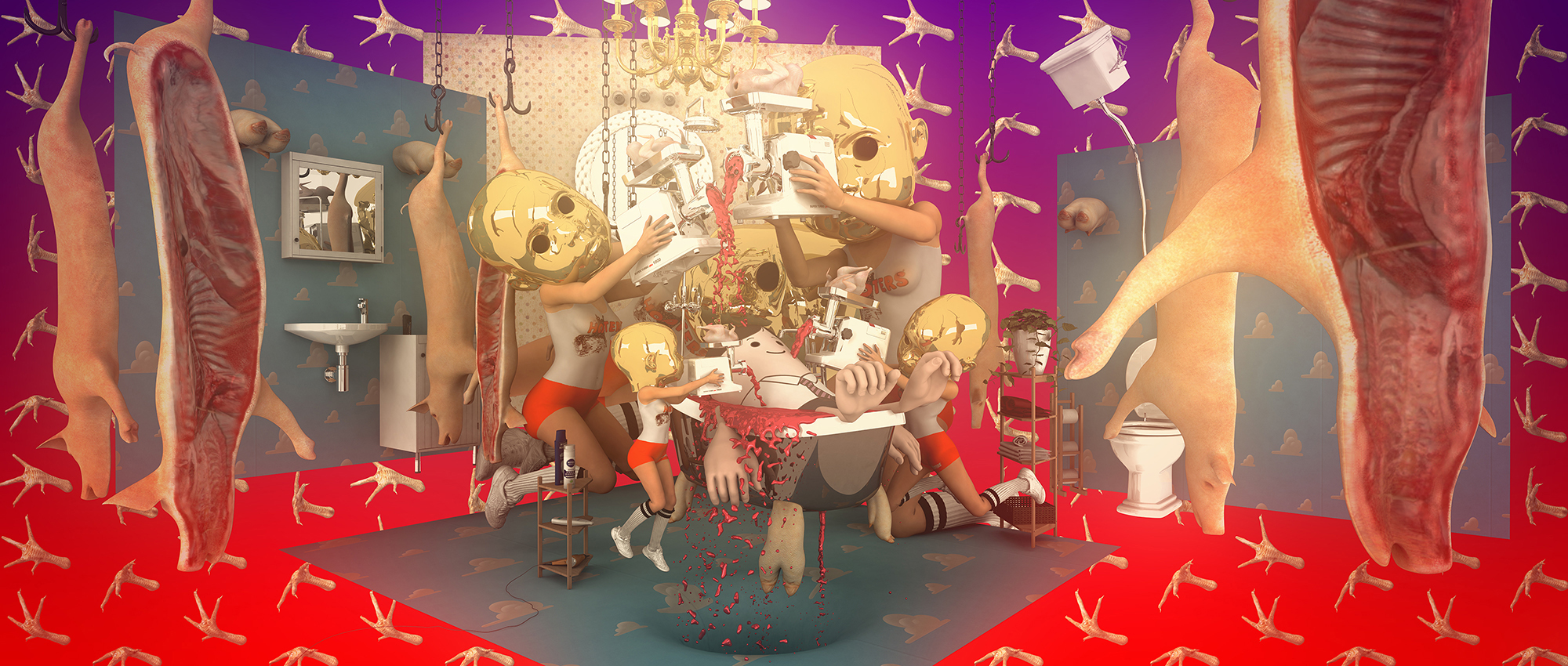
Digital America interviewed Maya Iskoz in April 2026 on their work I Long To Run.
:::

:::
Digital America: Your short video “I Long To Run” (2025) shows patterned socks “running” in front of wild horses pictured on a computer screen. The piece, which at first seems funny, or even absurd, points to something deeper you mention in your statement – an attempt to understand who we are versus how we’re perceived. You link this use of circular motion to a loop where movement doesn’t necessarily lead to progress. Could you elaborate on how your work challenges traditional ideas about purpose and productivity in Western narratives of self-development?
Maya Iskoz: Self-development and productivity to me are recursive processes. They are ongoing even though they’re sometimes framed as linear and having an endpoint. Purpose feels like something that is futile to chase, but we continue to reach for anyway. I’m a pretty nihilistic person, which isn’t to say that I’m a pessimist, but it feels that way in my work sometimes. “I Long To Run” has a feeling of melancholy to it as I mix my frustration with chasing purpose and meaning with thoughts about Labubus.
Digital America: Could you talk about your approach to pop culture in the piece and how they support the existential themes rather than interrupt them?
Maya Iskoz: Pop culture to me is the backdrop against which we experience personal and social catastrophes. Labubu is a cute character that represents mass consumerism and unsustainable demand. For example, I’m from Boston and I remember soap commercials on TV while watching live coverage of the Boston Bombing. I was pulled over once while listening to Lana Del Rey in the car. Commercial audiovisual forms exist with us always, because they are trying to profit somehow. It numbs us by presenting us with watered-down entertainment and dilutes meaning and poeticism. It’s never asking us to think – and that is the root which interests me most. Sentience in general is a base exploration in my practice. I think about animals a lot for the same reason.
Digital America: You describe your work as exploring “the gap between what something is and what it thinks it is.” The tension between the very grounded human feet and digital-looking background is extremely vivid and makes me wonder how through such visual choices do you approach the dilemma of the gap, and what experience do you hope to create for the viewer?
Maya Iskoz: Digital space feels like both a real place I live in and a completely imagined 4th dimension. I project myself into others’ minds through my computer. The mix of the digital and the physical in my work is an attempt at bridging external and internal experiences – basically ours actual tangible lives versus our interior abstract thoughts. I hope for viewers to consider what is between the inside and outside of their minds and bodies.
Digital America: In the movie, the contrast between the stillness of the human and the movement of the animals plays a significant role in exposing the gap between reality and perception . Could you talk more about what the horses represent, especially in relation to the idea of cyclical motion you mention in your statement? How do they connect to themes of freedom versus repetitive life?
Maya Iskoz: Wild horses running feels like the ultimate representation of freedom. I use horses a lot in my work, and it’s sort of like the Italian Futurist obsession with cars and war: I’m drawn to their speed and massive scale. They feel like mythical beings to me. In relation to cyclical motion, horses run to run, not only to reach a destination, and I think that’s how people are: we live because we live, not because we produce. Time keeps going.
Digital America: Your work often employs digital manipulation to recontextualize physical objects. This is evident in “Redshift” (2024), which uses toys and food to illustrate cosmological theories, as well as “Clone Dolly” (2024) – a piece that manipulates a digital imagery of the famous cloned sheep to explore themes of simulation. Could you talk about how this digital reinterpretation helps you address the tension between reality and perception?
Maya Iskoz: Taking a familiar object and manipulating it isn’t an original technique. Art to me is about decontextualizing objects and ideas I take for granted to see them in new ways. Digital reinterpretation specifically interests me because I can iterate and reform an object in a bunch of ways without actually changing the things itself. The temporality of the manipulation is the tension between reality and perception: with digital tools, I can clone as many Dollys as I want and put them in as many environments; I can reuse the same toys in multiple videos to world-build. I can build new realities without commitment.
Digital America: What are you working on now?
Maya Iskoz: I just finished two moving sculptures. One is a wind turbine with a Burger King kid’s meal toy embedded into it, and the other is a lenticular picture of fruit that gently moves from side to side.
:::
 Maya Iskoz (b. 2004, Boston MA) is a video artist and sculptor who has evolved enough to know that she thinks, but not enough to know why and how. To cope with this permanent confusion, her work looks at the gap between what something is and what it thinks it is, often drawing from scientific and spiritual explanations for existence. She searches in vain for answers in St. Louis MO and was a 2025 artist in residence at the Yale Norfolk Summer School of Art. Recent screenings of her video work include Videodrome at Espacio Odeon (Bogota, CO) and the VIII International Bad Video Art Festival (online).