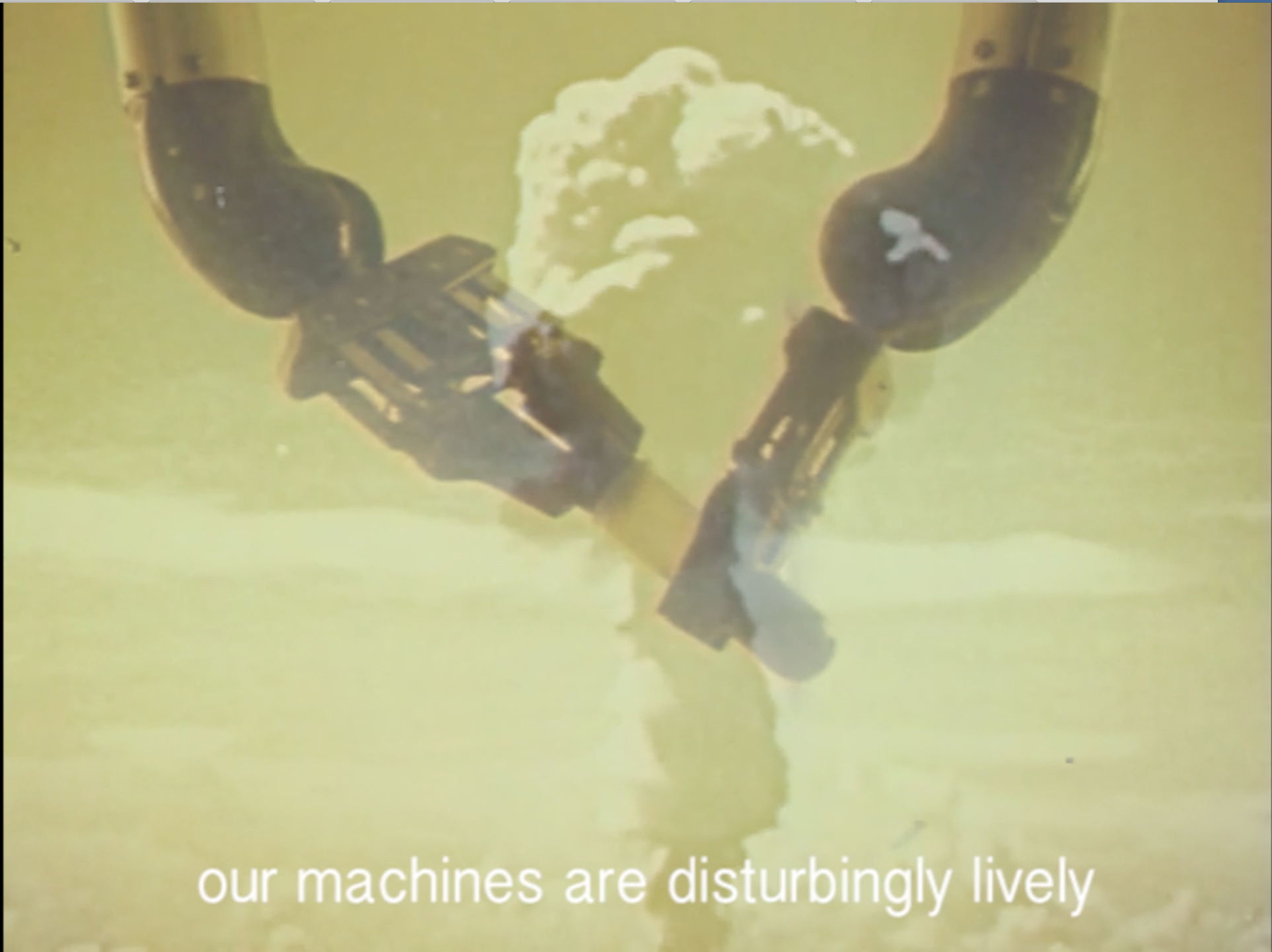
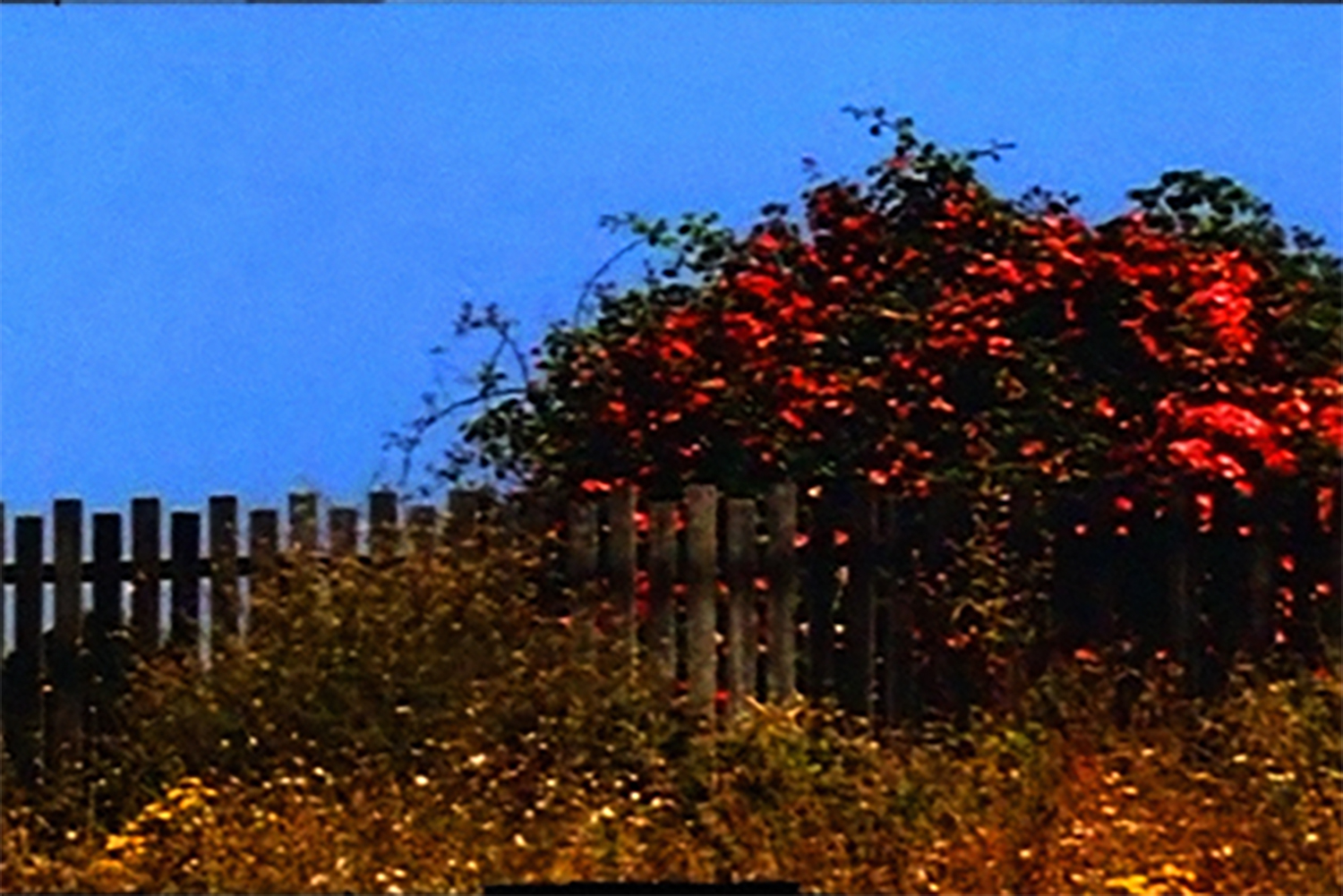
“Orientation,” 2025 a poetry film by Cody Tracy, presents a portrait of obsessive thought that continually returns to the past without resolution. Tracy gives a narrative perspective to Cacti, the cactus, allowing it to address its former self through a traumatic mode of reflection. Through fragmented nouns, adjectives, and verbs arranged poetically, alongside sound resembling the static decibel noise of a broken TV, Tracy evokes an experience that he describes as “memory and return: not linearly, not with resolution, but in the way intrusive thought actually moves.” I feel deeply connected to this specific film.
“Orientation” constructs meaning not through linear narrative but through the accumulation of collage-like fragments. The cactus’s interiority unfolds in scattered emotional beats, anchored by the existential question “How did / this happen.” Disjointed imagery, such as lions, men, and overwhelming high-decibel sound, interrupts and destabilizes the flow, ultimately resolving into a rhythmic yet unsettling refrain: “death is always near.” This section marks a shift into awakening, where the narrator attempts to impose order through documentation: seeking “The Light” and “The Dead.” Yet the film resists this structure. Fragmented language and unstable imagery disrupt any sense of continuity. The final realization, that “all I found were images,” suggests that memory and trauma cannot be fully captured, only mediated through incomplete and disjointed representations.
Understanding the meaning behind the artwork is not an easy task, as Cody leaves significant space for viewer interpretation. The sensation of looping intrusive thoughts is not only represented but also felt, as the film immerses the viewer in the process of thinking itself. It pushed me to question what these thoughts were, where they came from, and why they continued to return. That ambiguity becomes clearer when Cody reveals the work stems from his own experience, specifically, the thought spirals he had while working only with his left arm, turning the film into a deeply personal attempt to visualize trauma and obsessive reflection. Tracy reflects on his lived experience with OCD, deepening the interpretive framework of the film:
I think OCD, and obsessive thoughts in general manifest in nuanced ways and can be incredibly arresting to a person’s day. I know in my experience with OCD that my thought spirals can disrupt an entire afternoon, a day, and even at times, weeks. And these thoughts can be manifested from one simple awkward interaction, they could evolve over a more dramatic highly emotional issue, or even be brought on by the fear of taking the trash out to the curb. So what is collage, in this sense, but not an intuitive way to express a sort of cloudy mess of collected materials, much like a system of thoughts and potential OCD spirals.
Watching the film, I felt a deep emotional attachment to its images, text, and sound. It brought me back to a past relationship with someone who lived with OCD. Even though we are no longer together, I still hold a quiet care for him. At the time, I often found myself unable to fully grasp what he was going through. He tried to describe the relentless loops of intrusive thoughts in his mind, and I would sit with him, listening, hoping that somehow I could understand and help him carry them.
Our relationship ended not long after I experienced an accident and was diagnosed with a concussion. Those three days of being confined to bed were among the most difficult periods of my life. I was alone, left to confront a flood of intrusive thoughts, questions, and doubts about myself, my family, my relationship, and my future. The thoughts looped endlessly, and I found myself wishing I could escape them, even briefly, through distraction. I tried to talk it out with my family, my friends, and even my therapist, but nobody seemed to fully understand. I finally saw my partner within myself at the time.
Finally, after days sitting alone, I figured I could never find myself out of the loop unless I bravely confronted the thoughts.
The accident and the relationship have been over for some time now, and I have come to accept them with a sense of calm and gratitude. I see them as experiences I needed to go through to become who I am today. That is why I feel deeply connected to Orientation. I admire his courage in being open about mental health and vulnerability, and his willingness to translate those experiences into art. His film helps make visible emotions that are often difficult to articulate in words. Every emotion deserves to be seen and accepted for what it is; that is what makes us human. I wish this type of artwork could be seen more, so we could empathize with each other better as human beings.
:::
Check out Cody Tracy’s Orientation.

June Pham is a Junior at the University of Richmond, double-majoring in Rhetoric & Communication Studies and VMAP. She works as a Student Social Media Team member at UR and Spider Athletics and is very much interested in creative direction and how visual storytelling influences people. She loves cooking, traveling, taking 35mm film photos, and curating her Instagram feed in her free time.